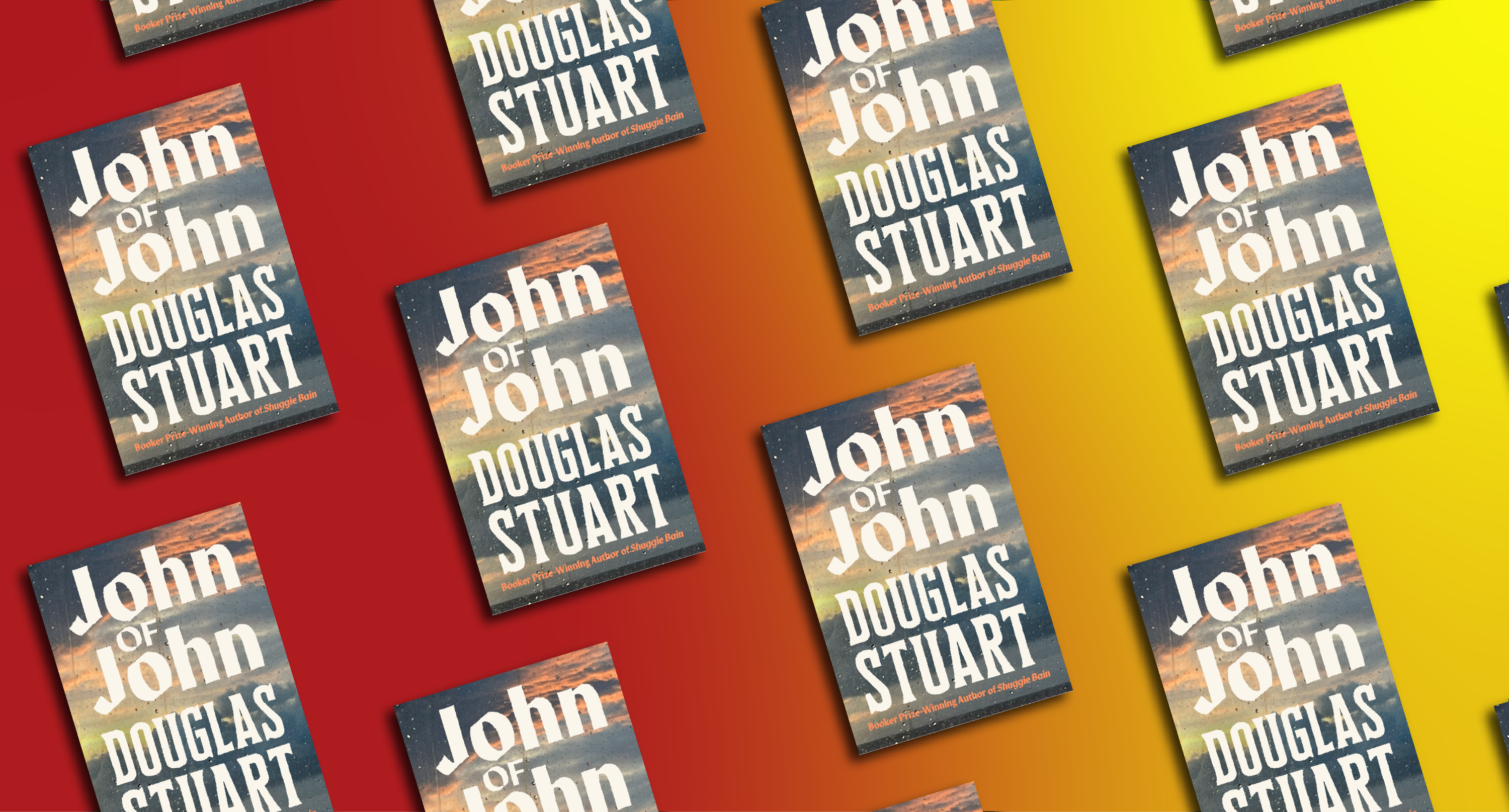
Author Douglas Stuart
Publisher Grove Atlantic
DOP May 5, 2026
Quick Take
John of John follows John-Calum Macleod, a 22-year-old gay art school graduate who returns home to the Isle of Harris after running out of money and options. Back in the windswept croft where he grew up, Cal finds himself caught between his strict Calvinist father John and his sharp-tongued Glaswegian grandmother Ella, navigating a community held together by faith, silence, and the kind of loyalty that can look a lot like suffocation. It is a novel of extraordinary atmosphere and real emotional weight that asks more patience of its reader than either of Stuart’s previous books.
About the Author
Douglas Stuart is the Booker Prize-winning author of Shuggie Bain and Young Mungo, two of the most acclaimed works of queer literary fiction of the last decade. Born and raised in Glasgow, he trained at a college of textiles before eventually turning to fiction, and has built a body of work rooted in Scottish working-class life, queer desire, and the particular damage families do to the people they love most. John of John is his third novel, and it draws more directly on his own biography than either of its predecessors.
What Is John of John About?
Cal comes home the way people do when they have no better option: broke, quietly ashamed, and braced for everything to feel exactly as small as he left it. A sheep farmer, tweed weaver, and pillar of the local Presbyterian church, his father John is a man shaped by decades of discipline and silence. Ella, Cal’s grandmother, is a Glaswegian outsider who never learned Gaelic and has never quite been absorbed into island life, keeping an uneasy peace with her son-in-law for years. Closeted and restless, Cal is trying to figure out whether there is any version of this life he can actually inhabit.
What the novel understands, and what gives it its particular texture, is that father and son are not simply opposites. They are the same kind of person at different points in the same life. Both are gay, both are hiding it, and Both are living inside a version of themselves that was built to survive this community rather than to thrive in it. Stuart makes this parallel legible early, then spends four hundred pages letting the weight of it accumulate.
What Goes Unsaid
The most distinctive thing about John of John is the way it uses silence as a narrative device. The novel is full of things characters know and don’t say, feelings they can’t name, truths that sit just beneath every exchange between Cal and his father without ever quite breaking the surface. Stuart is extraordinarily good at this. The gap between what these men communicate and what they actually mean becomes its own story running alongside the one on the page.
It makes for writing that rewards close attention. A scene that appears to be about the logistics of lambing season is also about a father watching his son and recognising something he has spent his whole life refusing to look at directly. A conversation about the church, or the state of the farm, or what Cal plans to do next, is also about two people who love each other and have almost no language for it. Stuart trusts the reader to hold both registers at once, and when it works, it is some of the most emotionally precise writing he has produced.
The risk is that it asks a great deal of patience. There are long stretches where the unsaid is doing so much of the work that the said feels thin, and the novel drifts rather than accumulates. Not every quiet passage earns its quietness.
The Setting, Which Does Almost Everything
The Outer Hebrides in John of John is not backdrop. It is texture, moral weight, and atmosphere. Stuart renders Harris with the same painstaking attention he gave Glasgow in Shuggie Bain: the wind off the water, the particular quality of light over open moorland, the slow rhythm of lambing and shearing seasons, the Gaelic woven into conversation like something structural. The result is some of the most immersive nature writing he has produced, and it is genuinely beautiful.
It also contributes to the pace problem. The island holds the novel the way it holds its characters: close, slow, reluctant to let anything move too quickly. Readers who fall into that rhythm will find something close to transportive here. Those waiting for the story to gather speed will find stretches that feel long, even when the prose is doing everything right.
Ella, and Everyone Else
Ella is the book’s great pleasure. Sharp, profane, and more perceptive than anyone around her gives her credit for, she functions as the novel’s moral compass and its comic relief simultaneously. That is no small feat in a book this serious about its own sadness. Crucially, she is also the character who understands what it costs to be an outsider inside a tight community. Stuart uses her history to mirror and deepen what Cal and his father are going through, without ever making the parallel feel schematic.
The wider cast of islanders is handled with the same generosity Stuart brings to all his fiction. He seems constitutionally incapable of writing a character who exists only to serve the plot. Even people who appear briefly carry the suggestion of full lives being lived just off the page.
Where It Sits Against the Other Books
Readers coming from Shuggie Bain will find a familiar pace and emotional register here. The atmospheric density, the slow accumulation of small cruelties and quiet tenderness, the sense of a world pressing in on people from all sides: it is recognisably the same writer, and in places reaches the same emotional depth. What it lacks is the narrative momentum of Young Mungo, which moved with a kind of terrible propulsion that made it almost impossible to put down. John of John asks you to sit with it, and over four hundred pages that is a significant ask.
That is not a failure of craft. It is a question of what kind of reading experience you are after, and whether you are willing to move at the speed this island demands.
Final Verdict
John of John is a novel worth reading, written by one of the most gifted prose stylists working in literary fiction today. Stuart loves his characters more than they love themselves, and that quality runs through every page. The father and son at the novel’s centre are rendered with real complexity. The setting is stunning, and what the book does with silence, inheritance, and the things queer men learn not to say to each other is genuinely moving.
It is also the hardest of the three to finish. Not because it fails, but because it is slow in the particular way that the place it depicts is slow. Worth your time. Best read on a holiday, or a long quiet stretch of days when you can let it breathe.