Ten years on, Hanya Yanagihara’s novel remains one of the most debated works in contemporary queer fiction. That debate is exactly the point.
A Little Life changed the way literary fiction could impact readers, not just within the queer literary world but well beyond it. It did this not by being comfortable, but by refusing to be.
Some books are absorbed into the culture quietly. A Little Life was not one of them. When it published in March 2015, it arrived like a weather event: a 700-plus page novel about the unrelenting trauma inflicted on a gay man, written by a presumably heterosexual woman, shortlisted for the Man Booker Prize and the National Book Award in the same year, described variously as a masterpiece and as exploitation. Garth Greenwell called it “the long-awaited gay novel.” Critics called it trauma porn. Andrea Long Chu compared Yanagihara to a child burning ants with a magnifying glass. The argument has never really stopped.
That is the first part of A Little Life’s legacy. The novel made the question of what queer fiction owes its readers impossible to sidestep.
The Book Greenwell Thought We’d Been Waiting For
Greenwell’s argument, made in a 2015 piece for The Atlantic, was serious and worth taking seriously. His claim was not simply that the novel featured gay characters, but that it engaged with aesthetic modes long coded as queer: melodrama, sentiment, grand opera, excess. He argued that Yanagihara’s willingness to violate the canons of contemporary literary taste, to embrace exaggeration rather than understatement, gave the novel access to emotional truths that more restrained writing could not reach. It was a defence of a particular kind of queer art, the kind that does not seek mainstream approval by making itself palatable.
The argument has merit. What the novel understood, and what its critics often missed, is that queer literary history has always had room for the operatic. Giovanni’s Room. Dancer from the Dance. The work of Tennessee Williams. Writing queer suffering at a pitch considered excessive in any other register is a tradition, not a failure. Yanagihara was not inventing this mode. She was extending it.
The Question of Who Gets to Write It
Whether she was entitled to extend it is a different question, and one the novel’s tenth anniversary has brought back to the surface. Yanagihara has never publicly identified as queer. She conducted no ethnographic research for the novel and has said Jude St. Francis arrived fully formed. For many readers, especially queer ones, this matters. The most widely read queer novel of the last decade came from someone who may not have lived inside the experience it depicts.
This is the tension the book has never resolved, and probably cannot. Queer writer Alexander Chee defended Yanagihara’s investment in queer life and letters, pointing to her decade of editorial work giving mainstream visibility to queer writing as editor-in-chief at T Magazine. But defending someone’s commitment to queer literature is not the same as defending a specific creative choice. Both things can be true.
What Jude St. Francis Actually Is
Jude is not a realistic character. Yanagihara said this herself: she wanted to write a protagonist who never gets better, someone whose suffering sits beyond the reach of conventional redemption. He is a figure of accumulation, an archive of harm, designed to test how much a reader can witness and still keep reading. The novel refuses to settle whether that project is legitimate art or something more troubling.
What it did do, regardless of how you answer that question, is give queer fiction a new set of problems to argue about. Before A Little Life, the dominant conversation about queer fiction concerned visibility and representation: were queer characters present, were they complex, did they survive? After it, the conversation shifted. Now the questions were about what kinds of suffering queer characters were permitted to carry, who had the authority to write that suffering, and whether emotional devastation in the reader was itself a legitimate artistic goal.
These are better questions. More interesting ones. They reflect a literary culture that had moved past simply demanding that queer lives appear on the page.
The BookTok Problem, and Why It Is Not Quite the Problem People Think
A Little Life found a second, far larger audience during the pandemic, when TikTok filled with videos of people crying their way through it. By 2023, related hashtags had accumulated over 120 million views. The 10th-anniversary edition, narrated by Matt Bomer, sold out. An Instagram account dedicated solely to the novel maintains over 65,000 followers a decade after publication.
The cultural commentary on this has been, on balance, ungenerous. The argument goes that BookTok aestheticizes suffering, turns literary pain into a performance of being wrecked, and reduces a serious novel to a badge of having survived something. There is something to this. The algorithm rewards extremity. Videos of people staring blankly at walls after finishing the final chapter are a different kind of engagement than the critical close reading Greenwell modelled.
What the Numbers Actually Tell Us
But the snobbery in that argument is worth naming. Millions of people, many of them young, many of them queer, picked up an 800-page novel about gay male trauma and read it to the end. They did not do this because it was easy. The emotional intensity of their response, however performed or algorithmically amplified, is evidence that the book touched something real. A novel with its own dedicated Instagram account, translated into over 30 languages, that inspired a West End production a decade after publication, is not a trend. It is something that lodged itself in people.
The reluctant five-star phenomenon, a term researchers use to describe readers who rate the book highly despite not wanting to, is a genuine critical data point. People are not giving A Little Life five stars because they enjoyed it. They give it five stars because they cannot account for what it did to them using any other vocabulary.
The Book That Will Not Put Itself Down
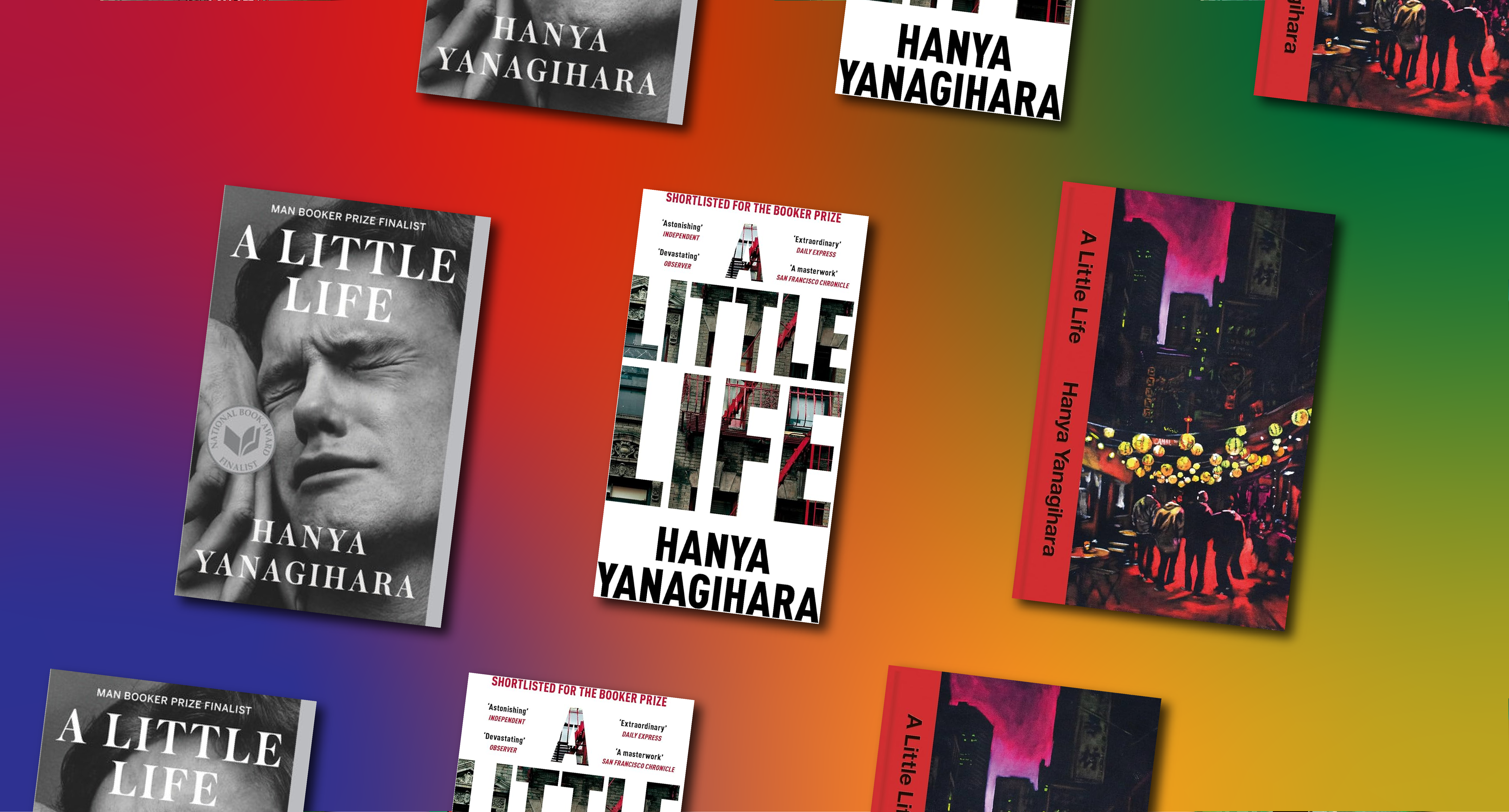
Here is what staying power actually looks like. Ten years after publication, you can still find Jude, Willem, JB, and Malcolm on merchandise. The iconic cover, a black-and-white close-up of a face shot by gay photographer Peter Hujar, has become one of the most recognisable images in contemporary literary culture. People hold it in front of their own faces for photos. The gesture has become its own language, a shorthand that needs no caption. You either know what it means or you are about to find out.
The x=x notation, the novel’s quiet internal grammar for selfhood and survival, still turns up as tattoos. Not in the way that a lyric from a song you loved at 17 turns up as a tattoo, something nostalgic and slightly embarrassing in retrospect. These are considered choices. People are still having it put on their bodies in 2025.
From Page to Stage to Skin
The 10th-anniversary edition arrived this year with a new audiobook narrated by Matt Bomer. It sold out. In 2023, Ivo van Hove’s stage adaptation sold out a West End run at the Harold Pinter Theatre, with James Norton as Jude and Omari Douglas, Luke Thompson, and Zach Wyatt as JB, Willem, and Malcolm. Critics split on whether the production carried the full weight of the novel, but Norton’s performance drew near-universal praise. The production later transferred to cinemas. A novel that generates that kind of theatrical event eight years after publication is not coasting on momentum. It is still building it.
The @alittlelifebook Instagram account, which launched alongside the book in 2015, one of the first major examples of a single novel having its own dedicated social presence, still posts multiple times a week. Fan art. Playlists. Photography. Readers’ annotations. The community it built did not disperse when the discourse moved on. It just kept going.
This is not what happens to books that are merely popular. Plenty of books sell well and vanish. What A Little Life did was different. It gave readers a shared vocabulary, a set of characters they felt they had lived alongside rather than simply read about, and a cover image that worked as a flag. The novel became infrastructure for a certain kind of reader identity. That infrastructure is still standing.
A novel about the inner life of a gay survivor of childhood abuse, with no genre hooks, no redemption arc, no happy ending, built a decade-long community of readers who make fan art and get tattoos and photograph themselves with the cover pressed to their faces. Whatever else you want to say about A Little Life, that does not happen by accident. It does not happen to books that do not mean something.
The Question It Left Open
The most honest thing to say about A Little Life‘s legacy is that it remains unresolved. It sits uncomfortably in the queer canon, placed there by readers who love it and disputed by readers who find its project extractive. It established, largely on its own, the cultural template for a certain kind of queer pain narrative in the twenty-first century, and then immediately became the thing other writers and critics had to push back against.
That is the mark of a significant book. Not a perfect one. Significance and perfection are not the same thing, and conflating them is one of the lazier moves in literary criticism.
Ten years on, Jude St. Francis has not left the culture. He probably will not. The arguments about what his story means, who had the right to tell it, and whether it serves queer readers or consumes them are still producing heat. That is what good literary controversy does. It does not resolve. It keeps asking the question.
Best for: Readers who have thought about the Bury Your Gays trope and want to argue about whether A Little Life complicates it or confirms it. Also for anyone who rated the book five stars and is still not sure how they feel about that.