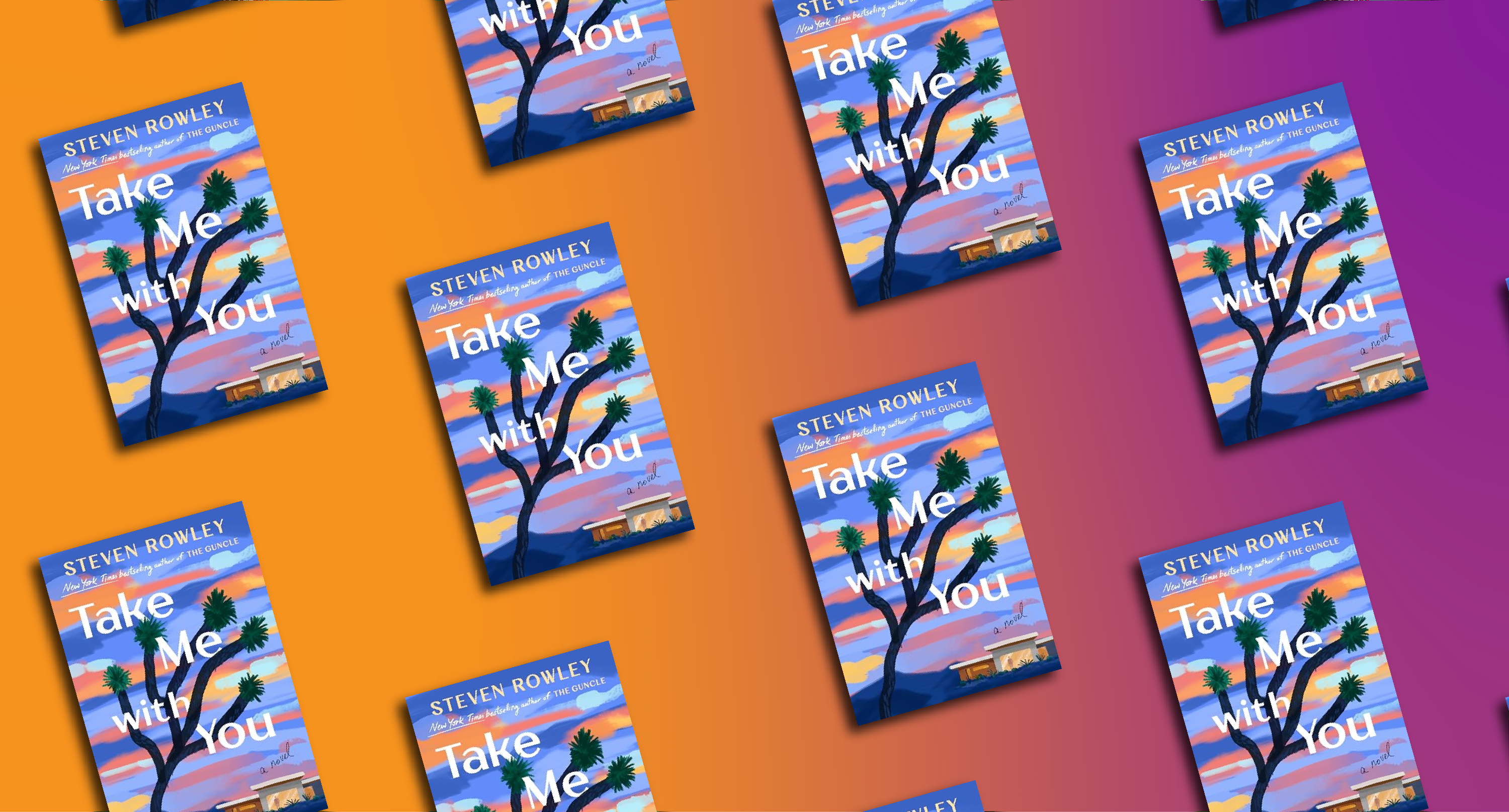
Author Steven Rowley
Publisher G.P. Putnam
DOP May 19, 2026
Quick Take
Take Me With You opens with one of the most absurd premises in recent queer fiction: a gay man watches his husband of thirty years walk into a beam of light in their Joshua Tree backyard and disappear into the sky. What follows is not a comedy, exactly. It is something richer. Steven Rowley has written his most emotionally ambitious novel, one that uses the wild logic of an alien abduction to tell a grief story that cuts right to the bone. The book was optioned for TV by producer Bill Lawrence (Ted Lasso, Shrinking) and Warner Bros. TV before it even had a chance to settle on shelves, which tells you everything about how immediately the story lands.
About the Author
Steven Rowley has built one of the most distinctive voices in queer fiction, and he has done it largely through the power of making people laugh while quietly wrecking them. His debut, Lily and the Octopus, used a dog’s illness as an allegory for grief so precise it left readers stunned. The Guncle won the Thurber Prize for American Humor and turned him into a household name in queer literary circles. The Guncle Abroad and The Dogs of Venice kept his campy, tender sensibility alive across different settings and tones.
But it is The Celebrants that has held up as the truest measure of what Rowley can do when he stops worrying about being funny and trusts the heart of his material. That novel about a group of friends who gather to celebrate each other while they are still alive is devastating in the best way. Take Me With You is the first time Rowley has felt like he learned that lesson and carried it fully into a new book.
On the day of publication week, Rowley announced the novel had been optioned for television by Bill Lawrence, the producer behind Ted Lasso, Shrinking, and Scrubs, through his production company Doozer, with Warner Bros. TV attached. The fit makes sense. Lawrence built his reputation on exactly the kind of comedy that knows when to stop being funny, and Take Me With You is that kind of book.
What Is Take Me With You About?
Jesse del Ruth is a college professor living in Joshua Tree with his husband Norman, an architect, when one night Norman walks into their backyard and vanishes into a strange beam of light. Just like that. Thirty years of shared life, gone in a moment he cannot explain or even entirely believe.
What Jesse faces next is both funny and genuinely painful. He has to figure out what to do with himself when the person who defined his daily life is simply no longer there. Norman’s sister Lally, a flight attendant, arrives with her own urgent need tied to Norman’s absence, and together the two of them orbit the shape of the man they have both lost. There is a conspiracy-theorist neighbor, a mysterious figure following Jesse, and a looming whether Norman left or was taken, and if the difference even matters.
Beneath all of that, the book is asking something much simpler and harder: what does it mean to stay?
The Allegory That Earns Its Heart
The alien abduction premise could have been a gimmick. In Rowley’s hands it becomes something else entirely. The book understands that grief over an absent person is a specific kind of loss, one without the clean closure of death. Jesse does not have a funeral to anchor his mourning. He does not have permission to stop hoping. What he has is a house full of the objects of a shared life and no idea what to do with any of it.
That ambiguity is exactly what makes Take Me With You land harder than a more traditional grief novel might. Because Rowley refuses Jesse the rituals of loss, he forces him to invent new ones. The gay experience of building your own structure for life because the inherited ones never quite fit runs through this book without ever becoming a thesis statement. It is just there, in the way Jesse thinks, in the way he and Norman had constructed their life together, and in the particular loneliness of being the one who remained.
The story trusts the reader to hold that weight without spelling it out. That trust is new for Rowley, and it makes the emotional payoff feel genuinely earned.
The Campy Heart, Now Deepened
Anyone who came to this book from The Guncle will recognize the comic sensibility immediately. The book is funny. The conspiracy-theorist neighbor is a wonderful creation. There is absurdist energy running through the premise that keeps the reading experience light even when the subject matter is not.
But where the Guncle books sometimes use humor as a cushion between the reader and the harder feelings, Take Me With You uses it differently. The jokes do not protect you from the grief. They sit alongside it, the way they do in actual life, where the funniest moments of a bad year arrive without warning and do not cancel anything out.
That balance is what The Celebrants got right, and it is what this book has now mastered. Rowley has learned to let his characters be funny and devastated at the same time, without one undermining the other.
Is Take Me With You Worth Reading?
If you loved The Celebrants and felt like Rowley’s more comedic books never quite matched what that novel did emotionally, this is the one you have been waiting for. It does not abandon his warmth or his wit. It just trusts them to do more.
Readers who come expecting a lighthearted comedy in the vein of The Guncle may find the pacing more contemplative than they expected. The book earns its laughs, but it is not primarily a funny book. It is a book about love and loss and what a long queer life actually looks like from the inside.
If that sounds like your reading, this will stay with you.
Final Verdict
Take Me With You is Steven Rowley at his most confident and most humane. The alien abduction premise is absurd and deliberate, a way of letting grief do what grief actually does: arrive without warning, refuse easy explanation, and leave you asking questions that have no good answers. The Celebrants remains the standard for what Rowley can do, but this book is closer to that standard than anything he has written since. It is a love story that understands love as something built day by day, and it aches for the loss of that in the specific way only queer stories tend to get right.