Canada Reads has been running for 25 years. Five books, five champions, four days of debate, one winner. It is the most watched literary competition in the country and one of the few places where Canadian fiction becomes genuinely national news.
Over that quarter century, queer books have competed, contended, and occasionally won. Some arrived early, before the culture was ready. While some came in and changed the conversation permanently, some came so close to winning that it still stings a little. And the 2026 shortlist, which features two explicitly queer-centered books, is the most LGBTQ+ forward the competition has ever been.
Here is the full history of every queer book that has made the Canada Reads shortlist since 2002. What the book was, who championed it, and how it fared.
The Early Years: Queer Books Before the Culture Caught Up (2002 to 2014)
For most of the first decade, queer content on the Canada Reads shortlist was rare and often indirect. The competition favored sweeping historical narratives, family sagas, and broadly appealing literary fiction. That is not unusual for a national competition trying to find “one book all Canadians should read.” But it did mean that LGBTQ+ stories operated at the margins, present but not centered.
A few titles in this era carried queer content worth noting.
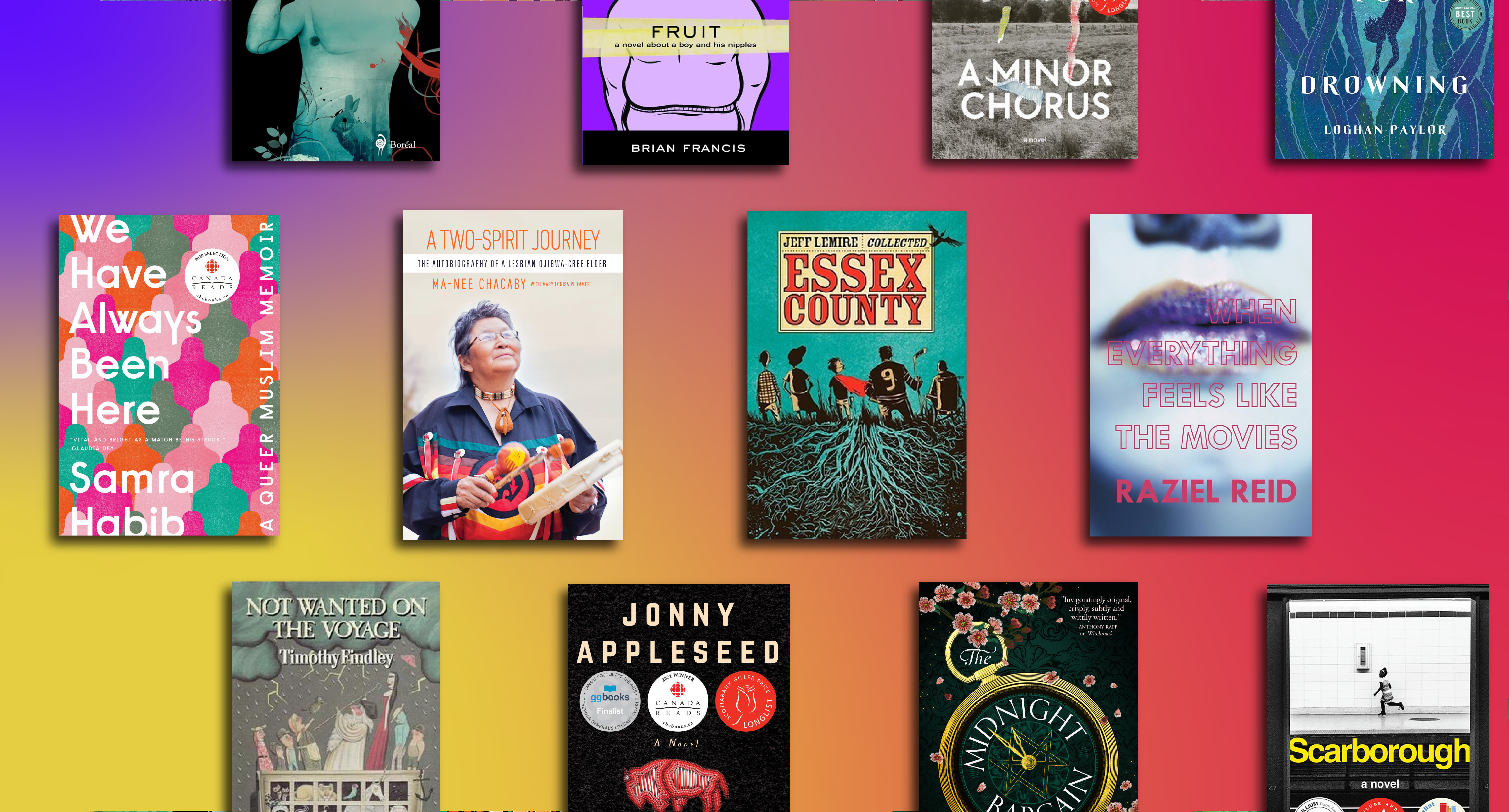
2008: Not Wanted on the Voyage by Timothy Findley
Result: Runner-up (eliminated on the final day)
Timothy Findley was one of Canada’s most beloved literary writers and was openly gay at a time when that was still unusual in Canadian public life. Not Wanted on the Voyage, published in 1984, retells the story of Noah’s Ark with a feminist and queer lens. Among those forced below deck is a character who can be read as gay, Noah’s son Ham, who fails to conform to the masculine ideal by eschewing violence. With him is the androgynous fallen angel Lucy, who is on a quest to find a place where difference does not bring discrimination and oppression.
In the final day of discussion, the celebrity panel first eliminated Thomas Wharton’s Icefields, leaving a choice between King Leary and Findley’s Not Wanted on the Voyage. Zaib Shaikh defended the book with conviction, but it fell to Paul Quarrington’s King Leary in the final vote.
It was one of the closest the competition had come to having a queer-coded book win.
2009: Fruit by Brian Francis
Result: Eliminated during the debates
This one deserves more attention than it usually gets. Fruit by Brian Francis is a semi-autobiographical coming-of-age novel about a gay boy growing up in small-town Ontario, narrated by the main character’s fat cells. It is funny, devastating, and deeply specific about what it felt like to be queer in a place where that word was still used as an insult.
Fruit: A Novel About a Boy and His Nipples by Brian Francis was championed by Jen Sookfong Lee in 2009. The book did not survive the debates, losing out in a year when The Book of Negroes by Lawrence Hill took the prize in a near-unanimous sweep. But its presence on the shortlist at all was notable for its time.
2011: Essex County by Jeff Lemire
Result: Eliminated during the debates
Jeff Lemire’s Essex County is a graphic novel trilogy set in rural Ontario, and one of the five characters in its intersecting stories is a gay man navigating silence and shame in a farming community. Essex County by Jeff Lemire was championed by Sara Quin in 2011. Yes, that Sara Quin, of Tegan and Sara, who’s sister would go on to champion another queer-centered book 15 years later.
Essex County did not win that year. The Best Laid Plans by Terry Fallis took the prize. But it was a meaningful inclusion. A graphic novel with an LGBTQ+ thread, championed by a queer artist, on the national shortlist.
2014: Annabel by Kathleen Winter
Result: Eliminated during the debates
Annabel is a novel about an intersex child born in remote Labrador in the 1960s, raised as a boy by his father while his mother secretly nurtures both sides of his identity. It is a quiet, lyrical book about gender, identity, and what we do to children in the name of making them legible to the world around them.
Annabel by Kathleen Winter was championed by Sarah Gadon in 2014. The Orenda by Joseph Boyden won that year. Annabel was eliminated before the final, but its inclusion signaled something shifting in what Canada Reads considered worth debating.
The Turning Point: Queer Books Gain Real Ground (2015 to 2019)
The second decade saw queer content on the shortlist become more explicit, more visible, and more competitive. Two key moments define this era.
2015: When Everything Feels Like the Movies by Raziel Reid
Result: Runner-up (second place)
This was a landmark moment. When Everything Feels Like the Movies is a YA novel about a gay teenager named Jude who refuses to be anything other than his flamboyant, celebrity-obsessed self despite relentless homophobia and violence. It was the first YA novel selected for inclusion on Canada Reads in 2015, where it came in second place.
The book had already won the 2014 Governor General’s Literary Award, making Raziel Reid, at 24, the youngest person ever to receive that prize. Its Canada Reads run generated controversy as well as enthusiasm. Some critics argued the sexual content was too graphic for a national platform. Others argued that was exactly the point. Reid was compelled to write the book about a real-life hate crime he had heard about as a teenager, one that Newsweek had called “the most prominent gay-bias crime since the 1998 murder of Matthew Shepard.”
Elaine “Lainey” Lui championed the book with energy and sincerity. It came in second place. A queer YA novel, rooted in a real anti-gay murder, reaching the final two on national television. That was new.
The Winning Era: Queer Books Take the Prize (2020 to 2025)
Something shifted around 2020. The competition began to reflect a broader sense of what Canadian literature could and should do. Three of the six Canada Reads winners between 2020 and 2025 came from LGBTQ+ authors or featured queer content at their center.
2020: We Have Always Been Here by Samra Habib
WINNER
Samra Habib’s memoir is the story of growing up Ahmadi Muslim in Pakistan, coming to Canada as a refugee, navigating racism and the threat of arranged marriage, and eventually finding her way to queer identity and chosen community. It won the Lambda Literary Award. It is a book about surviving multiple systems of oppression at once, and finding yourself on the other side.
We Have Always Been Here was defended by actor Amanda Brugel on Canada Reads 2020. It won. A queer Muslim memoir won Canada Reads. At the time, it felt enormous.
2021: Jonny Appleseed by Joshua Whitehead
WINNER
Joshua Whitehead’s debut novel follows Jonny, a two-spirit Indigiqueer young man who has left the reserve and works as a cybersex worker in the city to make ends meet. He must return home to attend his stepfather’s funeral and reckon with everything he left behind. It is raw, funny, and formally inventive.
Jonny Appleseed won Canada Reads 2021, championed by actor Devery Jacobs. Two-spirit and Indigiqueer representation winning back-to-back years. That had never happened before, and it meant something.
2021: The Midnight Bargain by C.L. Polk
Result: Eliminated during the debates
The same year Jonny Appleseed won, The Midnight Bargain by C.L. Polk was championed by Rosey Edeh. Polk is a queer author and the book, a fantasy novel with rich LGBTQ+ themes, did not win but contributed to what was a genuinely historic shortlist for queer representation.
2022: Scarborough by Catherine Hernandez
Result: Eliminated during the debates
Scarborough was championed by actor Malia Baker on Canada Reads 2022. Hernandez’s novel about a low-income Toronto neighbourhood features a queer Black performer named Kay as a central character. It did not win but its inclusion continued the pattern of queer Canadian stories being treated as essential national narratives.
2025: A Two-Spirit Journey by Ma-Nee Chacaby with Mary Louisa Plummer
WINNER
This was the winner the year before the current 2026 competition. A Two-Spirit Journey by Ma-Nee Chacaby won Canada Reads 2025. It was championed by Shayla Stonechild. In A Two-Spirit Journey, Ma-Nee Chacaby, an Ojibwa-Cree lesbian who grew up in a remote northern Ontario community, tells the story of how she overcame experiences with abuse and alcohol addiction to become a counsellor and lead Thunder Bay’s first gay pride parade.
A Two-Spirit memoir. Championed by an Indigenous advocate. Winner of Canada’s national book competition. The arc of what Canada Reads considers worthy of winning has changed dramatically.
2026: The Most Queer Shortlist in Canada Reads History
Which brings us here. The 2026 shortlist features two explicitly queer-centered books competing simultaneously, which has not happened before in the competition’s 25-year run.
A Minor Chorus by Billy-Ray Belcourt, championed by Elle-Máijá Tailfeathers, centers a queer Indigenous doctoral student navigating the weight of both identities in modern Canada. Belcourt has said he wrote it partly because there were almost no novels in Canadian literary history that had ever centered queer Indigenous life.
The Cure for Drowning by Loghan Paylor, championed by Tegan Quin, is a historical novel with a non-binary protagonist at its center, set during the Second World War. Paylor told CBC Books they searched archives for evidence that someone like them had existed before, driven by years of being the only openly trans or non-binary person in historical reenactment spaces. They want readers to feel empathy for people who are different from themselves, hoping the novel would “build bridges towards a kind of mosaic of better understanding.”
Both books are on the CBC. Both are being debated nationally. The debates run April 13 to 16.
What the Arc Looks Like
Looking at the full 25-year history, the pattern is clear. Queer books went from being coded and marginal, to present but unsuccessful, to competitive, to winning three times in six years. The 2026 shortlist has two queer-centered books competing at the same time.
Canada Reads is not a perfect institution. It has been criticized for its game show format, its celebrity panel choices, and a history of shortlists that took too long to reflect the full range of Canadian life. That criticism is fair. But the trajectory of queer representation on this stage is also real, and it is moving fast.
Tegan Quin captured it simply when she told CBC Books: “It’s so far and few between that you see that kind of representation.”
She was talking about The Cure for Drowning. But the sentence works as a summary of the last 25 years too. It used to be far and few between. It is becoming something else.
Want to read the books? We have a full guide to the 2026 Canada Reads shortlist, with a focus on the queer content and why it matters.