Trans literature is not a niche. It is one of the most vital, formally daring corners of contemporary writing, and it has been for decades. This list has one rule: every book here is written by a trans or nonbinary author. Not books about trans characters written by outsiders looking in. The actual work, in the actual words, of trans writers.
What follows spans five genres, from the literary fiction that built the modern trans canon to the poetry collections doing the strangest and most exciting formal work in the genre right now. Some of these books are decades old and still essential. Others are recent. All of them are worth your time.
Literary Fiction
Trans literary fiction has its own lineage, and it starts with the book most contemporary trans novelists are still writing in conversation with.
Nevada by Imogen Binnie
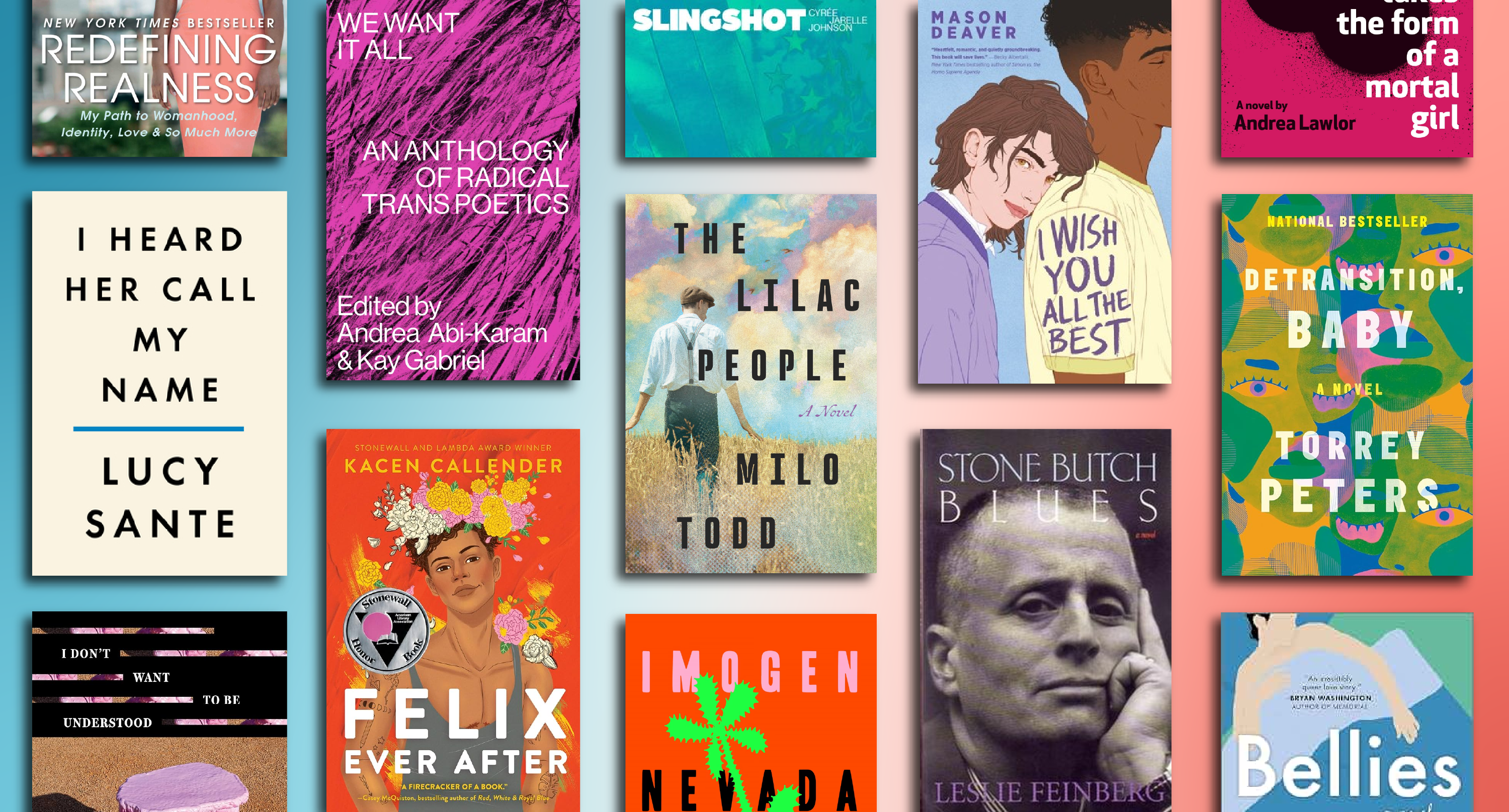
Originally published by Topside Press in 2013 and reissued by Farrar, Straus and Giroux in 2022, Nevada follows Maria Griffiths: an underpaid, depressed trans woman working retail in New York who breaks up with her girlfriend, quits her job, and drives west looking for something she can’t name. The prose is funny in a way that hurts. Binnie has no interest in making Maria likable or her transness legible to a cis audience. This is the book that proved trans fiction could be punk, ambivalent, and uninterested in redemption arcs.
A Safe Girl to Love by Casey Plett
Plett’s debut story collection, also from Topside, follows trans women across the American Midwest and Canadian prairie: halfway houses, family kitchens, bad relationships. It won a Lambda Literary Award. Plett has since published the novels Little Fish and A Dream of a Woman, and co-founded LittlePuss Press, now one of the most important small presses publishing trans writers.
Paul Takes the Form of a Mortal Girl by Andrea Lawlor
Lawlor’s shapeshifting protagonist Paul can transform his body at will. He spends the novel partying through queer scenes in early 1990s Iowa City, Provincetown, and San Francisco as both a gay man and a woman named Polly. It is horny, theoretical, and deeply funny, often read alongside Kathy Acker and the New Narrative writers, but written from a specifically trans and genderqueer vantage point those writers never had.
Bellies by Nicola Dinan
Dinan’s 2023 debut, winner of the Polari First Book Prize and a Lambda finalist, follows Tom and Ming, who meet at a university drag party and fall in love. The relationship fractures when Ming comes out as a trans woman. Dinan has said she wanted her characters to have the freedom to be flawed, even unlikable. Her follow-up, Disappoint Me, continues that commitment to messiness over moral clarity.
The Lilac People by Milo Todd
Todd’s debut novel, winner of the 2026 Lambda Literary Award for Transgender Fiction, follows Bertie, a trans man working at Magnus Hirschfeld’s Institute of Sexual Science in 1932 Berlin, through the rise of the Nazis and into more than a decade of hiding on a rural farm. When a young trans man collapses on their property near the war’s end, still in prison clothes, Bertie must protect him from Allied forces arresting queer prisoners even as they liberate everyone else. It is a novel about chosen family, erasure, and the trans histories that did not survive being written down.
Memoir and Essay
Trans memoir has always done more than document transition. The best of it interrogates what memoir itself can hold.
Stone Butch Blues by Leslie Feinberg
First published in 1993, Feinberg’s semi-autobiographical novel follows Jess Goldberg through the butch lesbian bars of 1970s Buffalo and into a masculine, ambiguously trans identity the era had no settled language for. It remains a foundational text for understanding how gender nonconformity and labor history intersect. The Feinberg estate still distributes it for free, because Feinberg insisted no one should be unable to afford it.
Redefining Realness by Janet Mock
Mock’s 2014 memoir traces her childhood in Hawaii, her decision to transition at eighteen, and her path into journalism and advocacy. It became one of the first trans memoirs to reach a genuinely mainstream readership. Mock writes with clarity and warmth that never flattens the harder material underneath.
Dear Senthuran by Akwaeke Emezi
Emezi is best known for fiction, but this Stonewall Award winning memoir, structured as letters to friends, mentors, and family, traces their path through chronic pain, heartbreak, and a literary career while refusing to translate their nonbinary, ogbanje identity into something legible for an outside reader. It asks to be read on its own terms or not at all.
I Heard Her Call My Name by Lucy Sante
Sante transitioned at sixty, after decades as a celebrated critic and memoirist. This 2024 memoir works backward through a life already extensively documented in her earlier writing, finding the version of herself she had not yet let surface. It made best-of-year lists at the New York Times, the Washington Post, and Slate. Few late transition narratives do what this one does.
Fairest by Meredith Talusan
Talusan’s memoir traces her childhood with albinism in the Philippines, her arrival in America, her years at Harvard, and her transition, refusing the tidy arc that trans memoir is sometimes expected to deliver. It sits at the intersection of race, disability, and gender without treating any one of those as the whole story.
Speculative Fiction
Trans writers have been doing some of the most formally inventive work in science fiction and fantasy for over a decade. The genre’s native tools (transformation, alternate embodiment, worlds with different rules) map directly onto trans experience in ways that realist fiction often can’t.
Meanwhile, Elsewhere, edited by Cat Fitzpatrick and Casey Plett
This 2017 anthology gathered twenty-five trans writers imagining other worlds and won the Stonewall Book Award. It is widely credited as the first major speculative fiction anthology assembled entirely by and for trans writers. LittlePuss Press brought it back into print in a portable edition with a new afterword. Start here if you want the broadest sense of what trans speculative fiction can do.
Detransition, Baby by Torrey Peters
Peters’s 2021 novel follows a trans woman, her detransitioned ex, and the cis woman pregnant with her ex’s child as the three circle an unconventional family structure none of them quite chose. It became the first novel by an openly trans author to be longlisted for the Women’s Prize for Fiction. It is funny in a way that refuses to soften its most uncomfortable observations about trans community, ambition, and desire.
Light from Uncommon Stars by Ryka Aoki
Aoki’s genre-blending novel follows a trans violin prodigy, a donut shop owner who turns out to be a retired intergalactic refugee, and a violin teacher who has made a literal deal with the devil. It won the Otherwise Award and was a Nebula finalist. It does something rare: treats a trans character’s interiority as worthy of cosmic stakes.
The Stars Are Legion by Kameron Hurley
Hurley’s far-future space opera unfolds entirely aboard living, organic worldships crewed by women. Hurley does not identify as trans, but the novel is frequently taught alongside trans speculative fiction for its radical reimagining of bodies, reproduction, and embodiment outside any binary structure. Pair it with the Fitzpatrick and Plett anthology for a fuller picture of the conversation it is part of.
Young Adult
YA by trans authors has produced some of the most widely read and most frequently challenged books in the genre. That tension tells you something about how much they matter.
Felix Ever After by Kacen Callender
Callender’s bestseller follows Felix Love, a Black queer trans teen who becomes the target of an anonymous transphobic harasser at his New York art school. It became the first novel by a trans author to win a Stonewall Book Award in the YA category. Callender has also written the adult novel Queen of the Conquered and the YA thriller We Are Villains, but Felix remains the work that introduced the largest audience to their voice.
I Wish You All the Best by Mason Deaver
When Ben comes out as nonbinary to their parents and is thrown out of the house, they move in with an estranged older sister and try to get through senior year without attracting attention. Deaver’s debut became a touchstone of nonbinary YA. It does not treat coming out as the end of the story, but as the beginning of a much longer, much more ordinary one.
Too Bright to See by Kyle Lukoff
Lukoff’s Newbery Honor and Stonewall Award winning middle grade novel follows Bug, who is grieving his uncle’s death and beginning to understand he is trans. A literal haunted house dramatizes the feeling of growing into a self no one around you can quite see yet. Lukoff, a former school librarian, has become one of the most challenged and most necessary authors writing for young trans readers.
Poetry
Trans poetry has built its own infrastructure of small presses and anthologies because the major prizes and review outlets have been slow to catch up. The resulting body of work is some of the most formally radical writing in the genre.
I Don’t Want to Be Understood by Joshua Jennifer Espinoza
Espinoza’s 2024 collection was a finalist for the Kingsley Tufts Poetry Award. It pushes further into the unsparing, image-dense style that made her earlier chapbooks cult favorites among trans readers. The title tells you what she is after: not legibility, but precision.
Slingshot by Cyrée Jarelle Johnson
Johnson’s debut collection, winner of a Lambda Literary Award, moves from a rural pastoral opening into urban landscapes shaped by disability, institutionalization, and survival. Johnson writes with a lyric precision that critics have called both amazing and perverse, in the best possible sense of both words.
We Want It All, edited by Andrea Abi-Karam and Kay Gabriel
This 2020 anthology of radical trans poetics gathers dozens of poets writing against capital, empire, and the expectation that trans poetry exists to explain trans people to anyone. It was a Lambda Literary Award finalist. It remains the broadest single entry point into where trans poetry is right now, formally and politically.
Where to Start
If you read one book from each section, start with Nevada for fiction, Stone Butch Blues for memoir, Meanwhile, Elsewhere for speculative fiction, Felix Ever After for YA, and We Want It All for poetry. Together they cover four decades and almost every register trans writing works in: funny, furious, tender, strange. None of them need a cis reader’s permission to matter, and that is exactly why they belong on this list.
For more LGBTQ+ reading recommendations, see our Essential Queer Books List and our coverage of Transgender Fiction at the 2026 Lammys.