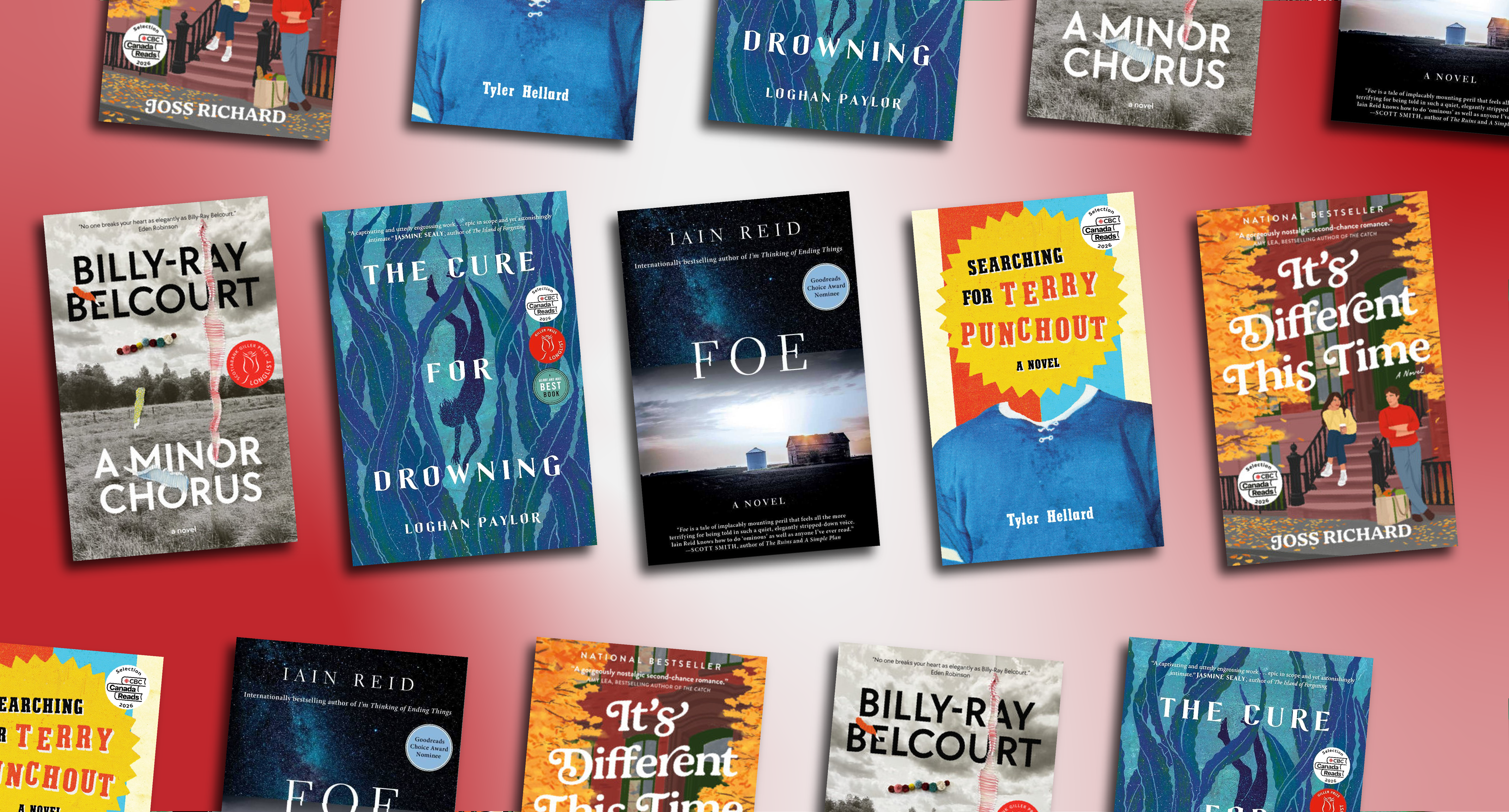
Every year, Canada Reads does something quietly radical. It takes five books, hands them to five champions, and asks the whole country to care about Canadian literature for four days in a row. It airs on the CBC. People argue about it at work. Libraries host events. It’s one of the few moments in the Canadian cultural calendar where the question “what should we all be reading?” gets treated like it actually matters.
This year, the answer to that question has a lot of queer in it.
The 2026 shortlist features five books debating from April 13 to 16. Two of them carry explicit, central queer representation. Not side characters. Not subtext. Two books where queerness is the whole point. Where LGBTQ+ lives get the same weight and seriousness that Canadian literary fiction has long reserved for other experiences.
We are living through a political moment where the existence of queer people is loudly contested, trans and non-binary people especially. In that context, CBC putting together a shortlist like this one is not a neutral act. It’s a statement about whose stories count as Canadian stories. Whose lives deserve four days of national debate.
Here’s everything you need to know about the five books, and why this year’s Canada Reads feels like a turning point for queer Canadian lit.
The Five Books
A Minor Chorus by Billy-Ray Belcourt
Championed by Elle-Máijá Tailfeathers
Billy-Ray Belcourt is a writer and academic from the Driftpile Cree Nation in Alberta. He was the first Indigenous person from Canada to receive a Rhodes Scholarship. He won the Griffin Poetry Prize at 22. And then he wrote a debut novel, A History of My Brief Body, that reads less like conventional fiction and more like a literary reckoning.
What the Book Is About
A Minor Chorus follows an unnamed narrator, a queer Cree doctoral student, who abandons his dissertation and returns to northern Alberta. What follows isn’t a plot-driven story in any traditional sense. It’s a series of conversations and encounters. A heart-to-heart with a fellow scholar feeling the weight of being a marginalized person inside a colonial institution. A meeting with a closeted man from his hometown navigating the loneliness of queer life on the margins. The haunting presence of his cousin Jack, caught in cycles of police violence and survival.
The queerness and the Indigeneity are inseparable here. Belcourt writes about what it means to be both, in Canada, right now. He’s said he wrote the book partly because Canadian literature had almost never centered queer Indigenous life.
That absence is itself the argument for this book.
Why It Matters
Champion Elle-Máijá Tailfeathers is a filmmaker and actor of Kainai and Sámi descent. Her choice of this book goes beyond a strong match between advocate and text. She describes the novel as a reminder to speak across divides, to have real conversations, to hold onto humanity. That’s a generous reading of a book that is, underneath its beauty, an act of radical insistence: these lives deserve serious literary attention.
A Minor Chorus made the 2022 Scotiabank Giller Prize longlist. Reviewers compare it to Ocean Vuong and James Baldwin. Experimental autofiction, lyrical and dense, not for everyone. But for the reader who meets it where it is, it’s devastating in the best possible way.
The Cure for Drowning by Loghan Paylor
Championed by Tegan Quin
This is the one that made us stop and catch our breath.
What the Book Is About
The Cure for Drowning is a historical novel set in Canada between 1939 and 1953. It follows Kit McNair, born Kathleen to an Irish farming family in Ontario. Kit has been a troublesome changeling since childhood. A daredevil who bristles at every expectation. At ten, they drowned in a river and came back changed, touched by their mother’s Celtic magic. When Rebekah, a German-Canadian doctor’s daughter, moves to the fictional town of Harrichford in spring 1939, she knows immediately who Kit is.
A love triangle forms. The war arrives. The three of them scatter and find each other again across more than a decade of Canadian and wartime history.
Kit is non-binary. Rebekah loves them. This is the center of the book, not a subplot. A trans and non-binary love story sits at the heart of a Canadian historical novel set during the Second World War.
The Story Behind the Story
Loghan Paylor is a queer, trans author based in British Columbia. They spent time working at a historical reenactment site in B.C. as the only openly trans or non-binary person there. Paylor used lunch breaks to search the site’s archives for evidence that someone like them had existed before. They found tantalizing hints, photographs, suggestive gaps in the record. That research became the seed of a novel imagining a history that is, as the publisher puts it, “truer than true.”
Historical fiction about queer people is still rare. Historical fiction that gives non-binary characters full interiority, full agency, full love stories is practically uncharted territory in Canadian literature. The Cure for Drowning landed on the 2024 Giller Prize longlist. The Globe and Mail named it a Best Book of 2024.
The Perfect Champion
Tegan Quin of Tegan and Sara is as perfect a pairing as Canadian literary culture can produce. She’s spoken about how natural the queerness feels in the novel. Not a cause to argue for. Just the texture of real human life. “It just felt so organic,” she told CBC Books. She’s not wrong.
Foe by Iain Reid
Championed by Josh Dela Cruz
Not every book on the shortlist carries queer content, and that’s fine. This is Canada’s national book debate, not a queer book club.
Foe is a taut, unsettling psychological thriller. Iain Reid also wrote I’m Thinking of Ending Things, and this book operates in the same territory: domestic unease, identity, the question of what makes a self. Junior and Hen live on an isolated farm. A man from a corporation arrives to tell Junior he’s been selected for a space program. The twist, when it comes, is genuinely disturbing.
Josh Dela Cruz champions this one. Blue’s Clues star, Broadway performer, he played Aladdin on Broadway, and an all-around Canadian treasure. He connects to the book’s ideas about living deliberately rather than on autopilot. Foe doesn’t carry queer content, but it asks big questions about selfhood, belonging, and who gets to determine the shape of your own life. That’s a conversation worth having.
Searching for Terry Punchout by Tyler Hellard
Championed by Steve “Dangle” Glynn
A sportswriter goes home to the Maritimes to write about his estranged father, a legendary retired NHL enforcer. This is the hockey book that turns out not to be about hockey. It’s about grief, failure, and the particular gravity of Maritime small-town life. Tyler Hellard is a Calgary-based writer. This debut novel earned shortlist spots for both the Kobo Emerging Writers Prize and the Amazon First Novel Award.
Steve “Dangle” Glynn is one of the most beloved voices in Canadian hockey media. He’s talked about how the novel “picked him,” which is exactly how the best books tend to work. No queer content here. But this is precisely observed, emotionally honest Canadian fiction.
It’s Different This Time by Joss Richard
Championed by Morgann Book
A cancelled TV actress gets a mysterious email. It pulls her back to the New York City brownstone she once shared with people she loved. She falls back into orbit with someone she lost. This is the romance novel of the shortlist, and a debut from a Canadian author. BookTok star Morgann Book champions it, putting it in front of a huge audience of young readers who care deeply about fiction centered on love and connection.
No widely noted queer content here. But the spirit of the book, second chances, chosen family, the life you almost had, speaks to something queer readers often find themselves drawn to.
What It Means That This Shortlist Exists
Canada Reads turns 25 this year. For most of that history, the competition skewed predominantly straight and white. That has been changing.
A Slow, Real Shift
Last year’s winner was A Two-Spirit Journey by Ma-Nee Chacaby, the autobiography of a lesbian Ojibwa-Cree Elder, championed by Shayla Stonechild. In 2020, We Have Always Been Here by Samra Habib, a queer Muslim memoir, took the prize. The shortlist has been opening up, year by year, to the full range of Canadian life.
Two explicitly queer-centered books on the same shortlist, debated on national broadcasting in 2026, still feels like something new. It’s worth saying that out loud.
The Books These Authors Needed
Loghan Paylor wrote The Cure for Drowning partly for their younger self — for a story they needed that didn’t yet exist. Billy-Ray Belcourt wrote A Minor Chorus in part because Canadian literature had almost never centered queer Indigenous life. Both of them made the national shortlist. Both of them are on the CBC.
Tegan Quin said something that stays with you: “It’s so far and few between that you see that kind of representation.” She was talking about The Cure for Drowning. She could have been talking about the whole arc of Canadian literary history.
The debates run April 13 to 16. We’re rooting for the queer books. But whatever wins, the conversation is happening at this scale, in this political moment, on national television. That already matters.
How to Watch Canada Reads 2026
The debates air April 13 to 16 at 10 a.m. ET on CBC Radio, CBC TV, CBC Gem, and CBC Listen. Watch outside Canada on the CBC Books YouTube channel. All debates are also available as a podcast. Ali Hassan hosts. He’s been doing this for ten years and he’s genuinely good at it.