A deep dive into the five finalists for the 38th Lammy Award in Transgender Fiction, and what they reveal about trans literature at its most urgent and necessary moment.
What Is the Lambda Literary Award for Transgender Fiction?
The Lambda Literary Award for Transgender Fiction honors the best novel or short story collection of the year. To qualify, books must center transgender experience and come from transgender authors. This is one of the most important categories in contemporary literary awards. It is also one of the most politically charged, largely because of when it came into existence and what has happened since.
A Category That Had to Be Created
For most of the Lammys’ history, there was no Transgender Fiction category at all. Trans writers and trans stories existed within the broader LGBTQ+ literary world. However, other categories often swallowed them whole. Books ended up in gay and lesbian categories, recognized only when their work fit that organizing logic. Many were simply overlooked.
The addition of transgender categories to the Lammys (fiction, nonfiction, and poetry) came after sustained advocacy. Bisexual and trans community members argued, correctly, that trans experience has its own literary traditions and its own communities of readers. Those deserved dedicated space.
Why the Timing Matters
This expansion happened at a pivotal moment. The years when transgender categories took shape coincided with a surge in public attention to trans lives. Some of that attention was celebratory. Much of it was hostile. Trans literature was gaining readers at exactly the moment when trans people were becoming targets of political legislation and social backlash.
That context has only grown sharper. In 2026, anti-trans legislation continues to spread. Trans books rank among the most banned in American schools and libraries. As a result, the Transgender Fiction category at the Lammys is not simply a niche award. It functions as a political act as much as a literary one.
The Literary Traditions of Transgender Fiction
Longer Than You Think
Transgender fiction has a longer history than mainstream culture tends to acknowledge. Writers like Leslie Feinberg were telling trans stories before the cultural vocabulary we use today even existed. Feinberg’s 1993 novel Stone Butch Blues remains one of the most influential works in the genre. Earlier still, Jan Morris published Conundrum in 1974 and Christine Jorgensen released her autobiography in 1967. Beyond those landmark books, trans community zines throughout the 1970s, 80s, and 90s built a literary archive that predates mainstream visibility by decades.
What Has Changed
What has shifted in the past fifteen years is not the existence of trans fiction but its reach. Trans writers now publish with major houses and find broad readerships. They also receive critical recognition in mainstream literary culture. Crucially, they continue publishing in small presses and community-based publications, the infrastructure that has always sustained trans literary life.
The 2026 Lammy shortlist reflects both traditions. It includes books from major commercial publishers alongside titles from small independents. It holds books aimed at broad audiences next to books in direct conversation with trans community history. That range is the point.
The 2026 Finalists for Transgender Fiction
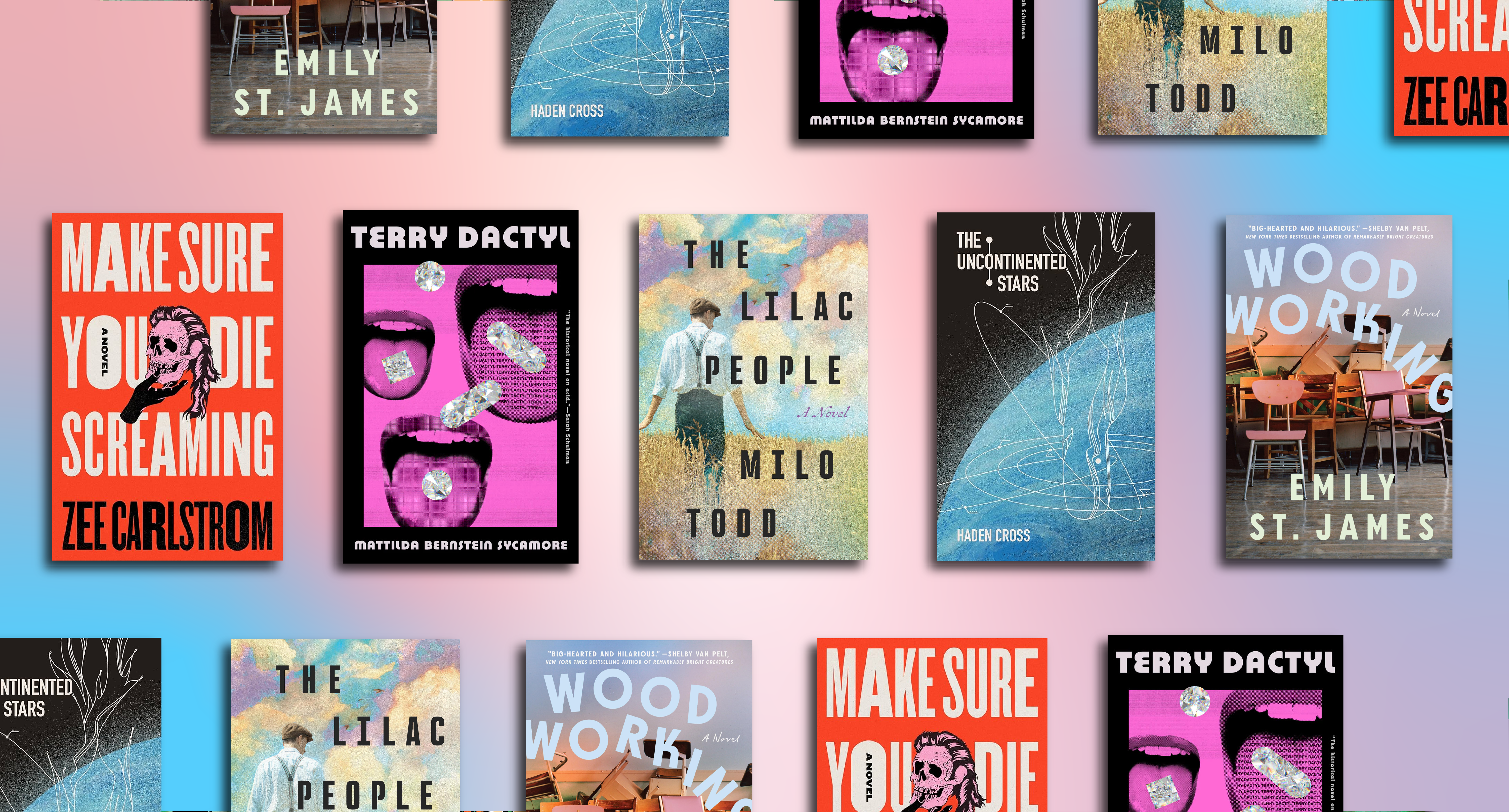
Make Sure You Die Screaming by Zee Carlstrom (Flatiron Books)
The Setup
It’s 2025, and America is, to use the novel’s own framing, thoroughly messed up. The narrator, known only as Gunderson, has rejected the gender binary, flamed out of their corporate job, and is probably brain-damaged after a violent fight with their ex-boyfriend Clinton. They’ve also, possibly, killed their best friend. When their mother calls to say their conspiracy-theorist father has gone missing in deep-red Arkansas, Gunderson makes an obvious choice: steal Clinton’s BMW, pick up Yivi, a self-proclaimed “garbage goth” teen from an Airbnb basement, and drive south.
What Follows
The road trip cuts through the heartland of a country coming apart. Mystery pills, a relentless stalker, cops who believe Gunderson committed murder, and some genuinely strange cult-adjacent things fill the journey. Beneath all that chaos, though, the novel delivers an honest interrogation of class rage, economic collapse, gender expression, and the political rupture dividing American families.
Torrey Peters, the author of Detransition, Baby, called it “Fear and Loathing for the generation devastated by the generation that brought us Fear and Loathing.” The Associated Press said it contains “almost everything: comedy, action, adventure, philosophical musings, banter, alcoholism, crimes, weird cult-y things, and even some modicum of closure.”
The Author
Carlstrom grew up in Illinois and works as a creative director in Brooklyn. Make Sure You Die Screaming made NPR’s Best Books of 2025 list and ranked among Goodreads’s hottest debut novels of the year. The LA Times praised it for “twining together anger and glee, hope and despair, alienation and community.” It is exactly as loud and alive as the title promises.
Terry Dactyl by Mattilda Bernstein Sycamore (Coffee House Press)
A Life in Full
Terry Dactyl has lived many lives. Raised by boisterous, loving lesbian mothers in Seattle, she comes of age as a trans girl in the 1980s. Dancing queens and late-night house parties surround her, even as the AIDS crisis begins to devastate the world she loves. Her mothers’ friends disappear one by one. Terry watches, absorbs, and survives.
Eventually, she moves to New York City and finds her people among the gender-bending club kids at the Limelight. Pageantry, drugs, and fierce loyalty hold them together. At a SoHo gallery job, after partying all night, she spends her days dragging club culture into the elite art world. Along the way, she falls in love with the glamorous Sid Sidereal.
Then and Now
Twenty years pass. During the panic of the COVID-19 lockdown, Terry returns to a Seattle stiffened by gentrification and pandemic isolation. When resistance erupts in the streets following the murder of George Floyd, her search for community ignites all over again.
Together, these two timelines span the AIDS crisis to COVID-19. The novel traces the full arc of a trans woman’s life, all its grief and glamour, without letting one overwhelm the other. The New York Times called it “a remarkably grounded look at what it means to be fully alive.” Publishers Weekly gave it a starred review, describing it as “a shimmering tale of art, drugs, and friendship.” Sarah Schulman called it “the historical novel on acid.”
The Author
Mattilda Bernstein Sycamore is a Lambda Literary Award-winning author and longtime activist. The San Francisco Public Library archives her papers. Coffee House Press, a nonprofit literary publisher with a decades-long commitment to formally adventurous work, is exactly the right home for this book. It is her most ambitious novel to date.
The Lilac People by Milo Todd (Counterpoint Press)
Berlin, 1932
Bertie is a trans man living in Weimar Berlin. He spends his evenings at the Eldorado Club, the beating heart of Berlin’s queer community, and his days working for Dr. Magnus Hirschfeld at the Institute of Sexual Science. At this brief, extraordinary moment in history, trans people can access documentation for their true identities, receive medical care, and live openly. Bertie is in love, employed, surrounded by chosen family, and cautiously hopeful.
Then Hitler Rises
The Institute is raided and burned. The Eldorado closes. Queer people are rounded up. Bertie barely escapes with his girlfriend, Sofie, to a nearby farm. There, the two take on the identities of an elderly couple and spend more than a decade in hiding, waiting for liberation.
In the final days of the war, a young trans man stumbles onto their property, still dressed in Holocaust prison clothes. Even with freedom approaching, safety remains out of reach. The Allied forces continue enforcing Third Reich laws against the “third sex.” There is no clean rescue waiting on the other side.
Recognition and Resonance
The Lilac People is a national bestseller, an ALA Notable Book, a Stonewall Book Award Honor title, and a finalist for the New England Book Award. The Boston Globe called it “heart-stopping in its suspense and dramatic reveals” and compared its structure to Anthony Doerr’s All the Light We Cannot See. The LA Times praised it as “exhaustively researched, gorgeously crafted and presciently timed.”
Many readers have noted how familiar the rollback of progress feels. In Hitler’s first two months in power, the novel shows, he erased passports, chosen names, and the small protections offered by medical professionals. Milo Todd is a Lambda Literary Fellow, a co-editor of Foglifter, and a teacher of creative writing to queer and trans adults. This is his debut novel. It will not be his last.
The Uncontinented Stars by Haden Cross (Self-published)
The Year 2776
Celebrated xenozoologist Abelard Cousteau returns five years after his assumed death following an accident in deep space. He seeks out his former protégé, Noah Starbuck, to join him on a mission. Their crew of eight must audit humanity’s first batch of exoplanet research bases, built after humanity narrowly averted climate collapse. The mission seems routine. But Abelard’s focus lies elsewhere: on the creature he believes caused his accident, the one he and Noah once studied only in theory, and the one he now wants to destroy.
Darker motives surface as the mission continues. Moreover, Abelard’s quest for revenge pulls at secrets of existence that may not survive being uncovered.
Why This Nomination Matters
The Uncontinented Stars is an openly queer, trans-authored reimagining of Moby-Dick, set 750 years into the future. It is also one of the most surprising nominations on the 2026 shortlist. Haden Cross published it entirely independently, no major press, no publicist, no marketing budget. Nevertheless, it earned a place alongside Flatiron Books, Coffee House Press, and Counterpoint Press. That is the Lammys doing what they do best: proving that the quality of trans storytelling has nothing to do with publisher prestige.
Self-publishing plays an increasingly vital role in the trans literary world. Traditional publishers have not always welcomed trans writers. Stories that center trans community concerns can struggle to meet commercial thresholds. As a result, many trans authors publish directly. A self-published trans sci-fi novel earning a Lambda Literary nomination is a signal worth taking seriously.
Woodworking by Emily St. James (Zando/Crooked Media Reads)
Mitchell, South Dakota, 2015
Abigail is seventeen and the only openly trans girl at her school. She plays the role of resident political dissident with competence and a little exhaustion. Mostly, she counts the days until she turns eighteen and can leave. Her plan is to spend her adult life “woodworking”, the trans community term for living as your true gender without disclosing your history, blending in so completely that no one ever has to know.
Then she learns that her English teacher, the recently divorced Erica, has just realized she is trans, at thirty-five, in the same small South Dakota town. Abigail is annoyed. She did not sign up to spend her senior year guiding her teacher through a transition. Still, she remembers what that uncertainty and loneliness felt like. So she helps anyway.
Two Trans Women, Thirty Years Apart
From there, the novel follows both women as they figure out what it means to be trans in a place that is not ready for them. The political moment is turning hostile. Between them, thirty years separate what “being trans” even looks like. Despite all that, or perhaps because of it, they find their way to each other.
Woodworking made the Best Books of 2025 lists at Vox, NPR, Elle, Autostraddle, the Chicago Review of Books, the Chicago Public Library, and the Brooklyn Public Library. It was also longlisted for the Center for Fiction First Novel Prize. The Washington Post wrote that St. James brings “smarts and heart” to the difficult task of writing a funny novel that also makes a compelling case for one of America’s most targeted groups. Shelby Van Pelt called it “big-hearted and hilarious, an ode to authenticity.”
The Author
Emily St. James spent years as one of the most widely read television critics in America, with work at Vox that shaped how a generation understood prestige TV. She has also written for Yellowjackets. What she brings to fiction is a novelist’s attention to structure and character, built through years of analyzing other people’s stories, and it shows throughout. The intergenerational friendship at the heart of Woodworking is a genuine addition to trans literature.
What the 2026 Transgender Fiction Shortlist Tells Us
Five novels. Between them: a gonzo nonbinary road trip through Trump-era America; a glittering, grief-soaked life of a trans woman from Seattle’s lesbian underground to New York’s club scene to the George Floyd protests; a historical novel about a trans man in Weimar Berlin watching fascism swallow everything he loves; a self-published trans reimagining of Moby-Dick set in 2776; and a warm, funny story about two trans women in South Dakota, one seventeen and one thirty-five, figuring it out together.
The publisher range spans Flatiron (major commercial house), Coffee House Press (nonprofit independent), Counterpoint Press (independent), a fully self-published title, and Zando/Crooked Media (newer independent partnership). Notably, this is not a shortlist that found its way to the same kind of book five times. Instead, it presents five writers doing five completely different things with trans experience, across five different publishing contexts.
Equally important is what none of these books do: exist primarily to explain trans experience to non-trans readers. All five treat the reader as ready for full, complex, demanding fiction. That is its own kind of progress, and precisely the kind the Lammys are built to recognize.
How to Read the 2026 Transgender Fiction Finalists
- For readers who want a gonzo, furious, deeply funny road trip through contemporary America: Make Sure You Die Screaming by Zee Carlstrom
- For readers who want a life fully lived, from AIDS-era club kids to COVID lockdowns: Terry Dactyl by Mattilda Bernstein Sycamore
- For readers who want historical fiction that recovers buried trans history with urgency: The Lilac People by Milo Todd
- For readers who want a self-published, queer sci-fi reimagining of Moby-Dick set 750 years in the future: The Uncontinented Stars by Haden Cross
- For readers who want a warm, funny intergenerational story about two trans women figuring it out in South Dakota: Woodworking by Emily St. James
The 38th Lambda Literary Awards ceremony takes place June 12, 2026, at Sony Hall in New York City. All finalists were announced March 18, 2026, by Lambda Literary.