
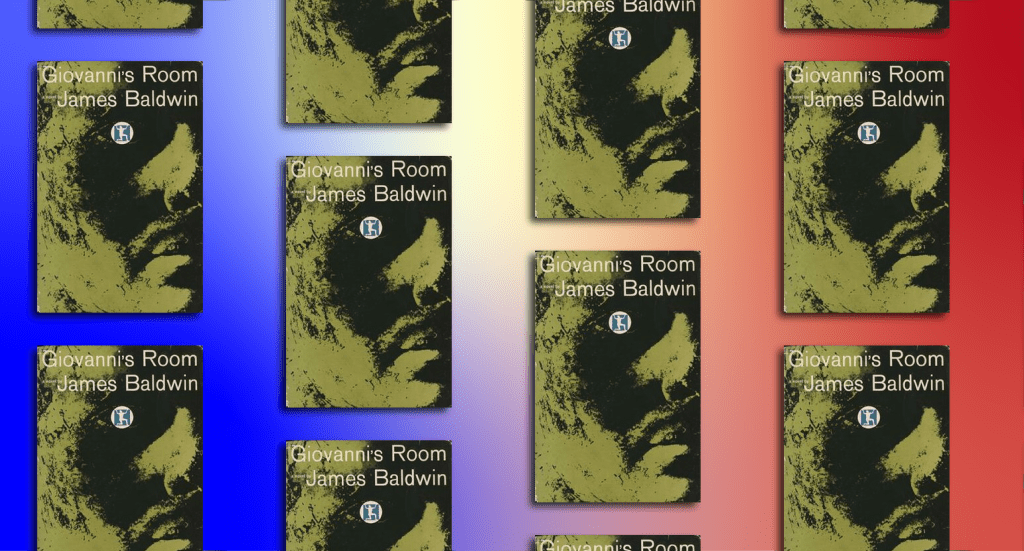
There is a version of history in which Giovanni’s Room never exists. In which James Baldwin, faced with a rejection letter and a command to destroy his manuscript, listened. In which one of the most important novels of the twentieth century, a book that has saved lives, shaped movements, and given language to feelings that millions of people had no words for, ends up in an incinerator somewhere in mid-century New York.
He didn’t listen, and in our humble opinion, Queer literature is immeasurably better for it.
Published in 1956, Giovanni’s Room is James Baldwin’s second novel: a spare, devastating, achingly beautiful story about an American man in Paris who cannot bring himself to love the person he loves. In fewer than 200 pages, Baldwin accomplished something that very few writers have managed before or since. He told the truth about what it costs to deny yourself, and he told it so precisely, so lyrically, that readers have been recognizing themselves in it for nearly seventy years.
This is the story of how that book came to be, why it nearly didn’t, and why it still feels, impossibly and urgently, like it was written for right now.
A Writer Refusing to Be Trapped
To understand Giovanni’s Room, you first have to understand the corner James Baldwin was being pushed into.
Baldwin was born in Harlem in 1924 and grew up in poverty, the eldest of nine children raised by a stepfather who was a preacher. By every account, he was extraordinarily gifted from a young age, a voracious reader who became a teenage preacher himself and who later, as a young man in Greenwich Village, fell under the mentorship of the novelist Richard Wright, who helped him secure a grant to begin writing seriously.
His debut novel, Go Tell It on the Mountain, published in 1953, was a triumph. Semi-autobiographical, set in Harlem, it dealt directly with the Black American experience through the lens of a Pentecostal church. It established Baldwin as, in the eyes of critics and publishers alike, a great Black American writer. Which meant they expected him to keep being exactly that.
As the History of Black Writing project at the University of Kansas documents, after his first novel’s success Baldwin later said: “I realized that I was being corralled into another trap. Now I was a writer, a Negro writer, and I was expected to write diminishing versions of Go Tell It on the Mountain forever. Which I refused to do.”
His refusal took a radical form. His second novel would feature an all-white cast of characters, be set entirely in Paris, and center on a love affair between two men. He would not be the kind of writer other people decided he should be.
Baldwin had moved to Paris in 1948, and the city had shaped him profoundly. He once wrote that Paris was, by its own legend, “the city where everyone loses his head, and his morals, lives through at least one histoire d’amour, ceases, quite, to arrive anywhere on time.” It was a place where he could see America more clearly from the outside, and where, as a gay Black man, he had room to exist that America had never really offered him.
The novel he began writing there drew on something real. He later explained in interviews that a real incident had planted its seed: he had met a man at a bar in Paris, and a few days later saw that man’s face in the headlines of a Paris newspaper. The man had been arrested and was later guillotined. That collision of beauty and catastrophe stayed with him. Giovanni’s Room begins on the morning of its protagonist’s lover’s execution.
According to Britannica, the novel was originally titled One for My Baby in draft form, and Baldwin dedicated the finished work to Lucien Happersberger, a painter who had been Baldwin’s lover during his years in Europe in the early 1950s.
“Burn It”: The Rejection That Almost Erased a Classic
The story of how Giovanni’s Room reached publication is one of the more remarkable acts of stubbornness in American literary history.
When Baldwin submitted the manuscript to Alfred A. Knopf, the publisher who had released Go Tell It on the Mountain, the response was devastating. According to the University of Sydney’s review of the novel’s history, editor Henry Carlisle pronounced it a failure and told Baldwin the novel would damage his reputation if published.
What happened next is somewhat contested in the record. Carlisle insisted the rejection had nothing to do with the book’s content. Baldwin, as documented across multiple scholarly accounts and interviews, believed otherwise. He thought Knopf could not stomach a story about homosexual love between a white American expatriate and an Italian bartender being told by a Black man from Harlem.
In interviews, Baldwin recalled being warned that the book would alienate his Black readership and ruin his career. As one widely cited account records, he was told the book would not even be published “as a favour to you.” His agent went further still and advised him to burn the manuscript.
According to LitCharts’ study guide on the novel, Baldwin fired his agent and took Giovanni’s Room to Dial Press, where it was accepted without hesitation.
One more detail from this period speaks to just how fraught the book’s publication was. When Dial Press agreed to publish it, they were not entirely without anxiety. As Mental Floss has reported, the publisher pulled Baldwin’s author photo from the book, apparently to conceal the fact that this novel about queer white characters had been written by a Black man. The fear of audiences and markets did not disappear when Baldwin found a publisher; it changed shape.
Despite all of this, Giovanni’s Room received a largely positive reception when it came out. The Atlantic, in its original review, declared that the book “belongs in the top rank of fiction.” The New York Times praised it for being written “with unusual candor and yet with such dignity and intensity.” The Saturday Review called it a work of “great artistry and restraint.”
Not everyone agreed. Some critics objected to its homosexual themes outright. Others, as documented in the academic journal Signs, were disturbed by the racial politics of the novel: a Black man writing white characters, refusing to center the Black American experience that critics had decided was his proper subject. One early review was titled, witheringly, “The Faerie Queenes.”
Baldwin had anticipated all of it. He had known what he was doing when he wrote the book. He had simply refused to care.
What the Novel Does
Giovanni’s Room is, on its surface, a relatively simple story. David, a young American man, has come to Paris ostensibly to find himself before returning home to marry his girlfriend, Hella, who is traveling in Spain. While she is away, he meets Giovanni, an Italian bartender at a Parisian gay bar, and they fall into a relationship that quickly becomes the most real thing in David’s life.
The novel is narrated by David on the night before Giovanni’s execution. Giovanni has murdered the bar’s owner after being fired and falling into desperation, and David is waiting out the hours until dawn, trying to make sense of how everything collapsed. The story is told in flashback, so the reader knows from the very first page that this ends in catastrophe.
What Baldwin is actually exploring, though, is not the plot. As he said in multiple interviews, the book, in his own words, is “not so much about homosexuality. It is what happens to you if you’re afraid to love anybody.”
That is the moral and emotional core of Giovanni’s Room: not the fact of same-sex desire, but the cost of running from it. David does not lack the capacity to love Giovanni; he loves him profoundly, and Baldwin makes this unmistakably clear. What David lacks is the willingness to accept that love. He cannot reconcile being the man he loves with the man he believes he is supposed to be.
His sense of who he is supposed to be comes from everywhere: from his father, who raised him with a low, lingering suspicion about his son’s masculinity; from American culture, which Baldwin understood had historically been terrified by intimacy between men; from the life he has outlined for himself in which a respectable future involves Hella and a conventional role. Giovanni’s room, the cramped, disordered apartment where they live together, becomes both a sanctuary and a trap. It is the only place David can be himself. He comes to hate it for that reason, externalizing his own shame onto the space where his shame is least necessary.
As scholar Matt Brim has argued, the tragedy of the novel is what he calls the failure of “queer imagination” — the inability to picture oneself as queer and to build a life around that reality. David can imagine the life he is supposed to want. He cannot imagine the life he actually wants. So he destroys both.
The prose Baldwin uses to tell this story is extraordinary. Irish novelist Colm Tóibín once described Baldwin, writing in The New Yorker, as “the greatest American prose stylist of his generation.” The language of Giovanni’s Room has the quality of feeling spoken onto the page — natural and intimate, but also precise in a way that keeps surprising you. Baldwin traced his style back to a mixture of the King James Bible, the rhetoric of the church, and what he called “something ironic and violent and perpetually understated” in the speech he grew up hearing. Having been a teenage preacher, he understood how language could move people, console them, and condemn them. That knowledge is on every page.
The Layers Beneath the Surface
Critical readings of Giovanni’s Room over the decades have found the novel doing considerably more than its surface story suggests.
Scholar Josep Armengol, in a study published in the journal Signs, argued that while the novel was long viewed as “raceless,” race operates throughout it in complex, deflected ways. In Armengol’s reading, Baldwin maps the dynamics of racial hierarchy onto the dynamics of sexuality: whiteness becomes associated with heterosexuality and propriety, while homosexuality becomes coded in ways that connect to Blackness, otherness, and outsider status. David regards himself as superior to Giovanni not only emotionally but through the lens of class and nationality, and the novel quietly critiques all of it.
As the Wikipedia article on the novel notes, scholar Valerie Rohy has argued that Giovanni’s Room participates in the tradition of the American expatriate novel while simultaneously engaging with questions of racial and sexual identity in ways that were radical for their moment and remain resonant today.
The novel also functions as an indictment of what American masculinity requires men to destroy in themselves. David’s self-denial does not only hurt him; it destroys Giovanni, disappoints Hella (who is, in her own right, a more complex character than she sometimes receives credit for), and leaves David entirely alone. The punishment Baldwin describes is not external. It is internal, self-inflicted, and total.
This is the novel’s most prescient quality, and the one scholars and readers have returned to for decades: the recognition that homophobia is not only a social force but a psychological one. When a society teaches people to find their own desires unacceptable, the damage is done from the inside.
The Milestones of a Growing Legacy
Giovanni’s Room did not immediately claim the canonical status it holds today. For decades after its publication, as the History of Black Writing project has noted, it occupied an awkward position, not fully embraced by students of Black literature because its characters were white, not fully embraced by students of gay literature because its author was Black, and arguably condescended to by a mainstream critical establishment that preferred the social urgency of Baldwin’s essays to what they considered an overly melodramatic novel.
That has changed considerably. The Publishing Triangle, an organization of lesbian and gay people in publishing, ranked Giovanni’s Room second on its list of the 100 best lesbian and gay novels, behind only Thomas Mann’s Death in Venice and ahead of works by Marcel Proust, Virginia Woolf, and Oscar Wilde. The BBC included it on its 2019 list of the 100 most influential novels. The Atlantic named it one of the Great American Novels of the past 100 years.
A well-known LGBTQ+ bookstore in Philadelphia took the novel’s name as its own. Giovanni’s Room, the bookstore, became one of the oldest and most beloved queer bookstores in America.
In 2024, the BBC broadcast a five-part radio reading of the novel. In 2025, the Quintessence Theatre Group in Philadelphia, with Phylicia Rashad as a creative consultant and Billy Porter as a production sponsor, staged the first theatrical adaptation approved by the Baldwin estate, to reviews that called it long overdue.
Why It Still Feels Written for Today
The question readers keep coming back to with Giovanni’s Room is: why does a novel set in 1950s Paris, written nearly seven decades ago, feel so contemporary?
Part of the answer is craft. Baldwin’s prose does not age because it does not rely on the trends of its moment. It relies on emotional truth, which has no expiry date.
The deeper answer is that the central experience of the novel, the experience of being taught to find yourself unacceptable, of loving in secret and paying for that secrecy with your whole life, has not become a historical artifact. For readers in countries where homosexuality remains criminalized, for queer people in families or communities where coming out means exile, for anyone who has spent years performing a version of themselves they know is false, Giovanni’s Room is not a period piece. It is a mirror.
As one recent review from Intersections, McGill University’s journal, put it: “Baldwin refuses to frame queerness itself as tragic; instead, he exposes how shame, fear, and moral rigidity corrode intimacy from within. David’s struggle is painful not because his desire is wrong, but because he lives in a world that teaches him to experience it as such.”
That sentence could describe 2026 as easily as 1956.
There is also the matter of what the novel says about masculinity and the particular damage done when boys are taught that to love is to lose, that vulnerability is weakness, that certain kinds of desire represent a failure of manhood. David’s father, who calls his son “Butch” and says he just wants David to “grow up to be a man,” is not a cartoonish villain. He is a recognizable figure. The forces that shape David’s self-destruction are not exotic. They are ordinary. That is what makes the novel so hard to put down and so hard to shake.
Why Readers Love It
Ask readers what they love about Giovanni’s Room and they tend to reach for the same few words: the prose, the honesty, the feeling of being seen.
Garth Greenwell, one of the most celebrated contemporary writers of queer fiction, has said: “Giovanni’s Room saved my life.”
That kind of testimony is not unusual. The novel has an unusual quality of feeling simultaneously universal and intensely private, as if Baldwin wrote it for the person reading it, regardless of who that person is or when they are reading. Straight readers recognize David’s cowardice. Gay readers recognize his desire. Everyone recognizes the cost of self-deception.
The novel is also, in a strange way, one of the more instructive texts about what not to do, not in a moralistic sense, but because David’s failures are so precisely observed that they illuminate the architecture of self-sabotage. Scholar Stephen Adams, writing in James Baldwin: Modern Critical Views, suggested that Baldwin “mourns the unrealized possibilities of homosexual love while celebrating its heroic and redeeming capacities.” Giovanni is not a tragic figure because he is queer. He is tragic because he is loved by someone who cannot admit it.
At barely 170 pages, the novel reads with the compression and inevitability of a Greek tragedy. Every sentence earns its place. It is the kind of book that reminds you what novels are capable of.
A Final Note on Courage
It is worth returning, at the end, to what it took to write this book.
James Baldwin was a Black man in 1950s America. He was openly gay at a time when being gay could get you fired, arrested, institutionalized, or killed. The people whose job it was to help him told him the book was a mistake, that it would end his career, that he should destroy it.
He wrote it anyway. He refused to burn it. He found another publisher and sent it into the world.
The result is one of the great acts of literary courage in American history: a book that told the truth when the truth was dangerous, that gave language to experiences that had no public language, and that has spent nearly seventy years finding its way into the hands of people who needed it.
Giovanni’s Room is not just a queer classic. It is a great novel. The distinction matters, because great novels do not belong only to the communities that first claimed them. They belong to anyone willing to sit with what they reveal.
Baldwin knew what he was doing when he wrote it. And he knew what he was doing when he refused to burn it.
James Baldwin (1924–1987) was a novelist, essayist, playwright, poet, and social critic. His works include Go Tell It on the Mountain (1953), Giovanni’s Room (1956), Another Country (1962), The Fire Next Time (1963), and If Beale Street Could Talk (1974). He spent much of his later life in the south of France, where he died in 1987. Giovanni’s Room remains in print and widely read.
Sources consulted: Sources consulted:
James Baldwin in Paris: On the Virtuosic Shame of Giovanni’s Room — Literary Hub
Giovanni’s Room — Encyclopaedia Britannica
10 Facts About James Baldwin’s Giovanni’s Room — Mental Floss
Revisiting James Baldwin’s Masterpiece, Giovanni’s Room — University of Sydney
Giovanni’s Room Study Guide — LitCharts
Giovanni’s Room — EBSCO Research Starters
My Latest Queer Literature Read: Giovanni’s Room — Intersections, McGill University


 Queer Book Club