
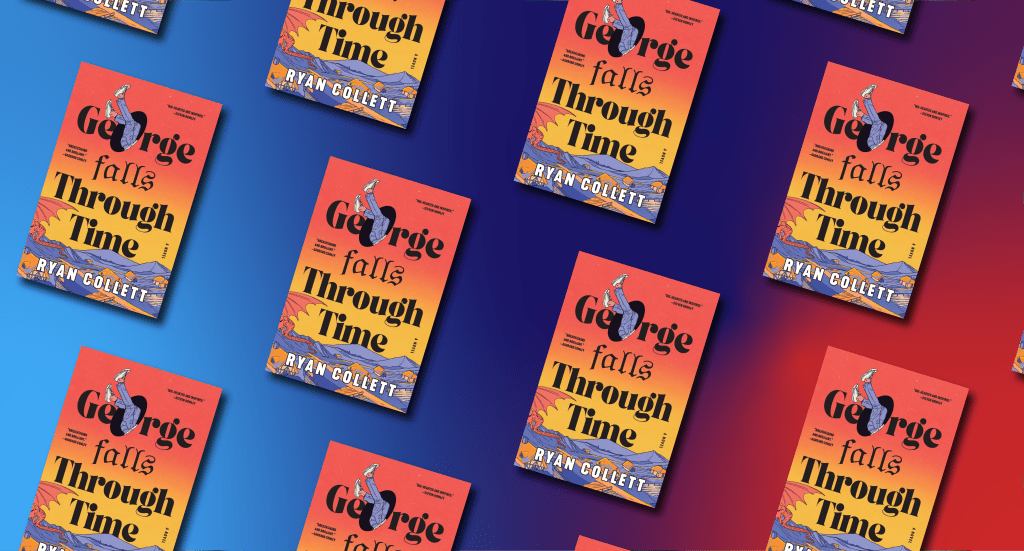
Author Ryan Collett
Publisher William Morrow
DOP January 20, 2026
George Falls Through Time is a thoughtful, quietly engaging novel that blends queer fiction, sci-fi fantasy, and emotional introspection into a story that feels both whimsical and grounded. Sitting somewhere between millennial malaise, low-grade ennui, and a full-blown burn-my-life-down moment, the book uses time travel not as a flashy gimmick, but as an emotional tool.
George, unsurprisingly, falls through a wormhole at the exact moment his life hits rock bottom. It is a narrative choice that feels immediately right. Rather than shocking the reader, it feels earned, as though the universe itself has responded to a life that can no longer move forward in a straight line.
Time Travel as an Emotional Allegory
As the story unfolds, George Falls Through Time reveals how a series of small choices, missed turns, and quiet acts of avoidance have led George to this moment. The sci-fi framework works best not as spectacle, but as metaphor. Time travel becomes a way to examine regret, self-reflection, and the desire to escape without ever feeling heavy-handed or moralizing.
The novel is especially effective at capturing the emotional texture of being stuck in your own life. George is flawed, sometimes frustrating, and deeply human. Watching him confront versions of himself through time feels less like a quest for correction and more like an exercise in understanding how people become who they are.
Fantasy Elements That Add Depth, Not Distraction
Experiencing the 1300s through a modern lens is genuinely fun and immediately recalls the spirit of A Kid in King Arthur’s Court, but with a much queerer and more introspective sensibility. That contrast gives the book both its charm and its emotional weight.
The fantasy elements, particularly the dragon, are a highlight. The novel offers a fresh and surprisingly thoughtful take on the origin of dragons, framing them not just as mythical creatures but as vessels for meaning. The absolution and absolvation the dragon provides George feels symbolic rather than literal, offering a form of emotional release that aligns beautifully with the book’s larger themes of forgiveness and self-acceptance.
Rather than overpowering the narrative, the sci-fi and fantasy aspects deepen it, reinforcing the idea that sometimes healing requires stepping outside of linear time altogether.
A Quietly Resonant Queer Sci-Fi Journey
By the end, George Falls Through Time is a satisfying journey to have taken with George. The novel does not promise transformation in the traditional sense. Instead, it offers something quieter and arguably more honest: understanding. George does not emerge fixed or perfected, but more aware of how he arrived where he is, and what it might mean to move forward.
For readers who enjoy queer speculative fiction, character-driven time travel stories, or novels that explore identity through genre rather than despite it, George Falls Through Time is well worth picking up. It is reflective, imaginative, and emotionally grounded in a way that lingers long after the final page.
 Queer Book Club